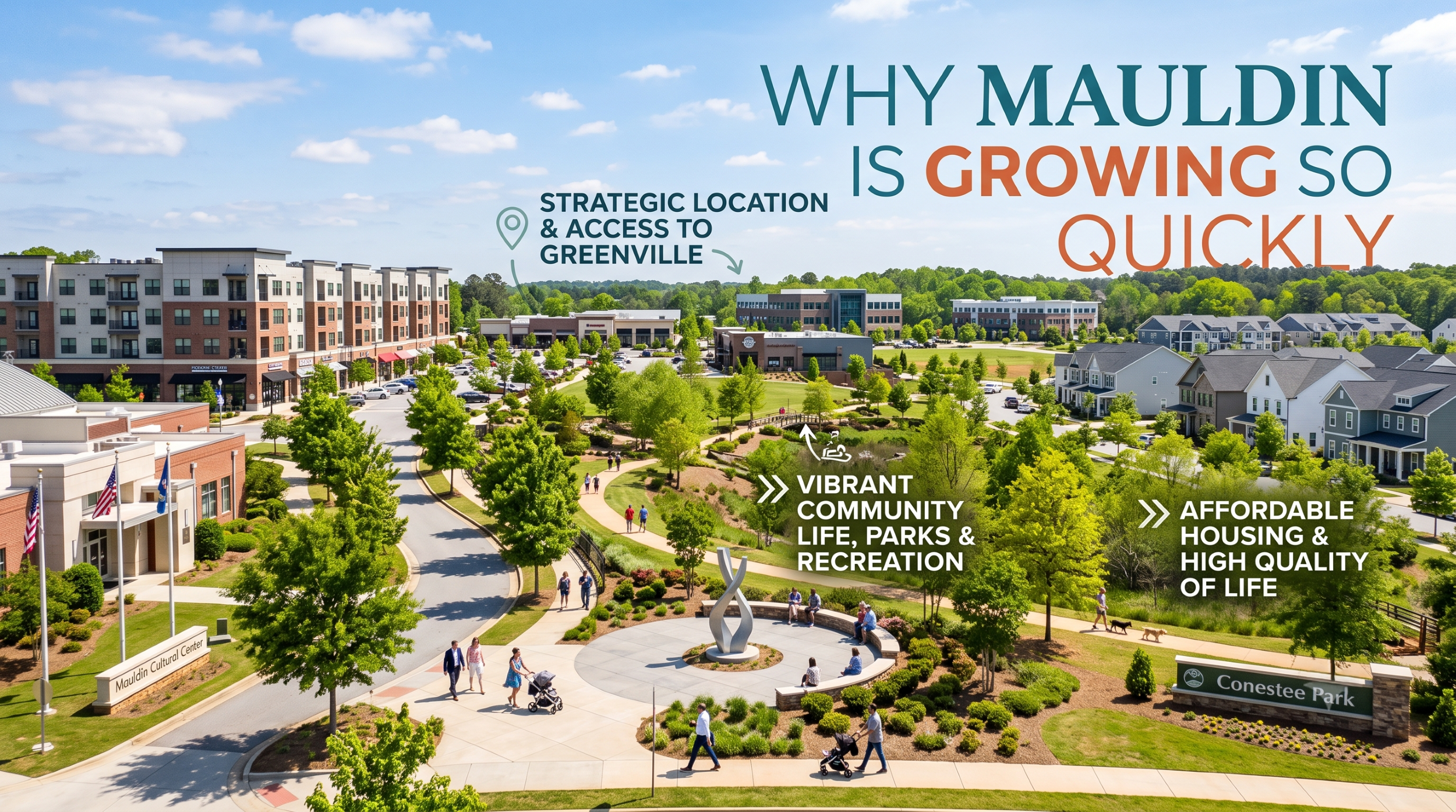
Mauldin was easy to overlook a decade ago. A quiet Greenville commuter suburb with strong schools but not much identity of its own. That has changed dramatically. Mauldin has emerged as one of the most dynamic growth stories in the Upstate, and the trajectory looks likely to continue for years to come.
Here is what I see as a working agent watching this market — what has driven the growth, why it matters for buyers and sellers, and where I think Mauldin is headed.
BridgeWay Station Changed the Trajectory
The most visible driver of Mauldin’s growth has been BridgeWay Station. The mixed-use development brought national attention, drew retail and residential investment, and elevated Mauldin’s profile from commuter suburb to destination.
The development itself continues to expand. Residential inventory alongside retail, restaurants, office space, and event venues has created walkable urbanism that the surrounding area lacked. For a city of Mauldin’s size, BridgeWay Station represents an outsized amenity.
The ripple effects have been broader than the development itself. Neighborhoods within reasonable distance have appreciated. Restaurants and services outside BridgeWay have benefited from the increased foot traffic and residential density. Mauldin as a whole has felt the effect.
Location Has Always Worked
Mauldin’s location advantages predated BridgeWay Station and continue to support the growth story.
Direct access to I-385 makes downtown Greenville a short commute. For professionals working in Greenville, Mauldin offers reasonable pricing without the compromises of longer commutes from more distant suburbs.
Access to the Greenville healthcare corridor, downtown business districts, and cultural amenities keeps Mauldin practical for buyers whose lives happen partly in Greenville proper.
Proximity to Simpsonville and the broader Greenville southern suburb network offers additional flexibility. Mauldin is close enough to Simpsonville and Fountain Inn that buyers can access what those communities offer without living there.
Schools Remain a Consistent Draw
Mauldin sits inside Greenville County Schools, which anchors much of the city’s ongoing appeal for families. Specific schools zoned to Mauldin addresses have generally performed well and continue to draw family buyers who want the schools without paying Greenville-proper prices.
The connection between school demand and housing appreciation is direct. Families continue moving to Mauldin for the schools, which supports both new construction demand and resale values.
New Construction Has Accelerated
Production builders and townhome developers have found Mauldin’s combination of location, schools, and BridgeWay-adjacent appeal compelling. New construction has grown across single-family, townhome, and mixed-use segments.
Townhome development in particular has expanded meaningfully. The buyer pool for townhomes near BridgeWay Station has been deeper than many developers anticipated, and the inventory continues to turn over as it is built.
Single-family new construction in the areas surrounding Mauldin has also accelerated. Families and downsizers have supported new communities in and near the city, with pricing that reflects the ongoing demand.
For a look at what active new construction inventory looks like across the broader area, Greenville new homes covers builder activity across the eastern and southern suburbs.
The Cost Advantage Over Greenville Proper
Mauldin has maintained a meaningful cost advantage over Greenville-proper inventory. Buyers who want reasonable proximity to Greenville amenities but do not want to pay Greenville-proper prices have consistently found value in Mauldin.
That cost advantage has narrowed as Mauldin has grown, but it remains real. Comparable single-family homes in Mauldin often run meaningfully less than equivalent inventory in Greenville-proper neighborhoods.
For a broader view of both markets, Mauldin real estate and Greenville real estate together show the price and inventory differences buyers see when comparing.
Employment Base Continues to Support Growth
Mauldin does not have a single dominant employer the way BMW anchors Greer or the Inland Port anchors parts of Spartanburg County. Instead, Mauldin’s employment story ties into the broader Greenville-Spartanburg regional employment picture.
Healthcare, professional services, manufacturing, logistics, and retail all employ Mauldin residents across the surrounding region. That diversity has actually been an advantage — Mauldin is not overly dependent on any single employer sector, which supports stability.
Remote work has added another dimension. As remote and hybrid work has grown, Mauldin’s appeal to workers who need to reach the office occasionally but do not commute daily has strengthened.
Who Is Moving to Mauldin
The Mauldin buyer pool has diversified alongside the growth.
Young professionals working in Greenville who want to buy their first home in a place with real amenity access at reasonable pricing.
Families relocating from out of state, particularly to jobs in the broader Greenville area, choosing Mauldin for schools and value.
Empty nesters downsizing from larger suburban homes elsewhere in the region who want walkable amenities without downtown Greenville pricing.
Retirees drawn to the combination of amenities, healthcare access, and reasonable cost of living.
Second-home buyers using Mauldin as a base for extended stays in the Upstate.
Investors targeting rental property in a market with strong tenant demand.
The Housing Market Response
Growth has driven measurable changes in the housing market.
Prices have appreciated steadily but not dramatically. The pace has been healthy rather than volatile.
Days on market for well-priced homes have stayed short. Well-prepared homes in good condition sell quickly.
New construction absorption has stayed strong, particularly for townhomes near BridgeWay Station and single-family homes in strong school zones.
Investor activity has grown but remains a smaller share than in some markets. Owner-occupant demand still dominates.
What the Growth Means for Different Market Participants
For buyers, the growth story means Mauldin remains a reasonable market for reasonable prices, but you cannot afford to be indecisive. Well-priced homes move quickly, and the buyers who are ready to act tend to win competitive situations.
For sellers, the growth story supports strong pricing for well-prepared homes. Preparation still matters — overpriced or poorly prepared homes still sit — but the market rewards quality inventory.
For investors, Mauldin offers stable rental demand with reasonable cap rates for well-selected property. Cap rates have compressed as prices have risen, but the underlying fundamentals remain supportive.
For long-term holders, Mauldin’s trajectory supports continued appreciation. The city is not going to slow down abruptly, and the compound effect of steady growth adds up.
Risks Worth Watching
Growth stories are not immune to reversals, and Mauldin has its own risks.
Traffic and infrastructure pressure is real. As the city grows, roads, schools, and services face pressure. How the city responds affects both quality of life and property values.
The broader economy affects Mauldin alongside the rest of the Upstate. Recessions, interest rate spikes, and employment shocks would all affect the local market.
Over-building is worth watching. If new construction outpaces buyer demand, absorption slows and pricing pressure builds.
None of these are reasons to bet against Mauldin, but they are factors worth understanding as you make specific real estate decisions.
Where I Think Mauldin Is Headed
Mauldin’s growth trajectory looks durable for the foreseeable future. BridgeWay Station continues to expand. New construction continues to absorb well. The buyer pool remains diverse.
I expect continued steady appreciation rather than dramatic spikes. That is arguably the healthier trajectory. Steady growth supports both current owners and future buyers.
I expect the walkable urbanism trend to expand beyond BridgeWay Station. Mauldin has caught on to what walkable, mixed-use design can do, and future developments are likely to follow that pattern rather than reverting to standard suburban form.
The Long View
Mauldin has evolved into a real destination market with its own identity. The growth is not going to stop soon, and the fundamentals support continued value creation for buyers, sellers, and investors alike.
If you want to look at what the growth means for a specific property, a specific neighborhood, or a specific buying or selling decision, that is exactly the kind of conversation worth having with someone who works this market. Reach out and we can dig into the specifics.