Basements aren't standard in Upstate homes the way they are in Northern markets. That's the first thing buyers relocating from Ohio, Pennsylvania, or the Midwest notice when they start touring. Most Upstate homes are built on slab or crawlspace foundations. Homes with real basements are the exception, and finding one takes specific searching.
Here's what basement-home shopping actually looks like in the Upstate and where the inventory tends to sit.
Why Upstate Basements Are Uncommon
Climate and soil conditions in the Upstate don't require basements the way northern climates do. Foundations don't need to sit below the frost line. Slab and crawlspace construction is faster, cheaper, and works fine here.
Topography matters too. Basements make more sense on sloped lots where a walkout basement adds usable space with natural light. On flat lots, a basement adds cost without adding much practical value compared to a slab or crawlspace foundation.
The result is that Upstate basement homes cluster in specific areas — hillier neighborhoods, older established communities where basements were more common, and higher-end custom construction where the buyer specifically wanted the space.
What Basement Buyers Actually Want
Buyers searching for basement homes usually want the space for specific reasons:
- Additional living space without expanding the footprint. Family rooms, home theaters, gyms, or hobby spaces that don't fit on the main floors.
- In-law or guest suite space. Basements with separate entrances work well for multi-generational living or extended-stay guests.
- Storage. Real storage that doesn't compete with living space or garage space.
- Home office space. Since 2020, more buyers need dedicated workspace, and basement offices work for buyers who want separation from main-floor family life.
- Cooler summer refuge. Basements stay cooler than upper floors in Upstate summers.
Where to Find Basement Inventory
Greenville homes with basements covers the Greenville inventory. The concentration tends to be in established neighborhoods with rolling topography — parts of North Main, some Eastside neighborhoods, and specific communities where slopes support walkout basements.
Spartanburg homes with basements covers the Spartanburg-area inventory. Older Spartanburg neighborhoods have more basements than newer suburban construction. Historic homes near downtown and in the established residential districts often include basement space.
Anderson homes with basements covers the Anderson inventory. The topography in parts of Anderson County supports walkout basements, particularly in the lake-adjacent areas and the more established neighborhoods.
The Walkout Basement Advantage
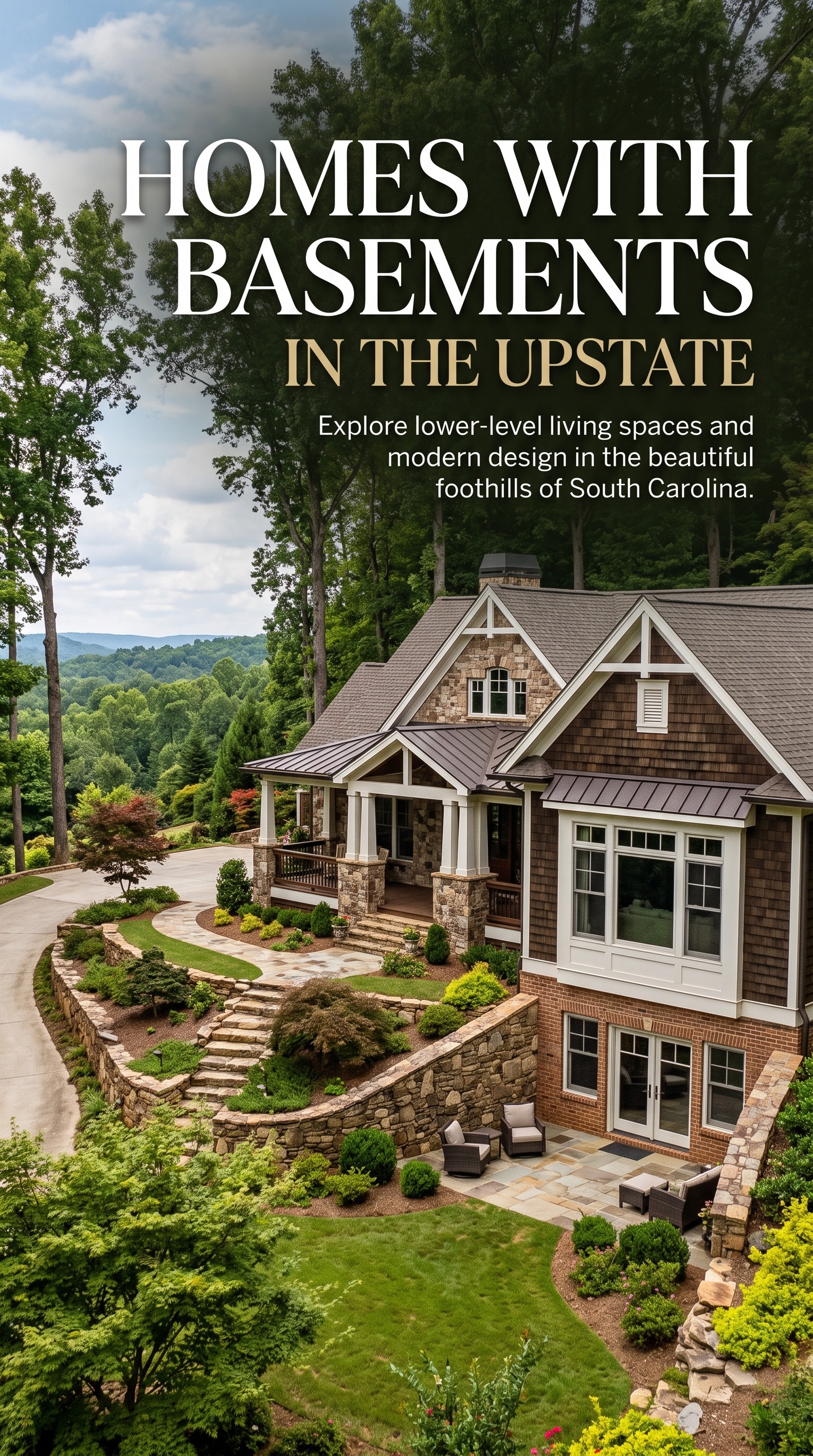
The best Upstate basement homes usually have walkout basements. Sloped lots let the basement level exit at grade in the back or side of the home, which brings natural light, proper egress, and often the ability to use the space as fully finished living area.
Walkout basements often function as complete lower levels rather than storage spaces. Finished walls, tile or hardwood floors, real windows, and full-height ceilings make them feel like additional home rather than utility space.
Full underground basements (no walkout) exist but are less common. They tend to have smaller windows, less natural light, and work better for storage or utility than for daily living space.
 What to Check When Touring Basement Homes
Basements need specific attention during home inspection:
- Water intrusion is the biggest concern. Look for stains on walls, floor cracks, efflorescence (white mineral deposits from water seepage), and any smell of dampness. Ask the inspector to specifically evaluate the basement for moisture history.
- Sump pumps and drainage. Some Upstate basements have sump pumps to handle groundwater. Check that the pump works and understand the drainage strategy.
- Egress windows. Any bedroom in a basement legally requires egress-sized windows. Verify compliance if the basement includes what's marketed as bedroom space.
- Insulation and finish quality. Some finished basements were done with attention to moisture management. Others weren't. Poorly insulated basements can grow mold. Ask about the finish work.
- HVAC coverage. Some basements are heated and cooled by the main home's HVAC. Others have separate systems. Verify what serves the space.
- Radon. Radon testing is worth doing for any basement space, especially finished basements used for daily living.
Basement Homes in Family Neighborhoods
For families, basement homes offer real advantages. Space for kids that doesn't clutter the main living areas. Recreation rooms. Home theater setups. Playrooms. In-law suites that let extended family visit for extended stays without disrupting the main household.
These features drive demand for basement inventory. Families often prioritize basement homes over otherwise-comparable homes without them.
Pricing Considerations
Basement space adds value but not dollar-for-dollar with main-floor space. Finished basement square footage typically appraises at less than main-floor square footage. Unfinished basement space adds less value still, though it adds utility.
Ask your agent to explain how basements affect comparable sales in your target market. Homes with basements often appraise higher than homes without, but the premium varies by neighborhood and buyer pool.
What Buyers Relocating Should Know
If you're moving from a Northern market and basements were standard, adjust your expectations for the Upstate. Basement homes exist but are the exception. Finding one may take a longer search than finding equivalent inventory without basement space.
Consider whether you actually need the basement or whether you can meet the same needs with different floor plans. Some Upstate homes offer bonus rooms, finished garages, or lower-level walkout family rooms that deliver similar functionality without a full basement.
For buyers weighing the broader Upstate market, Greenville real estate, Spartanburg real estate, and Anderson real estate each have basement inventory in different concentrations. Broaden your search area and you'll find more options.
The Long View
Basement homes will remain a specific niche in Upstate real estate. Builders are unlikely to shift toward basement construction as the default because the climate and soil don't require it. The inventory of existing basement homes stays essentially fixed.
For buyers who specifically want basement space, that fixed supply supports value over time. Well-maintained basement homes hold pricing power against comparable homes without.
If basement space is on your must-have list, reach out and we can put together a search that focuses specifically on the neighborhoods and inventory where basement homes actually exist.