


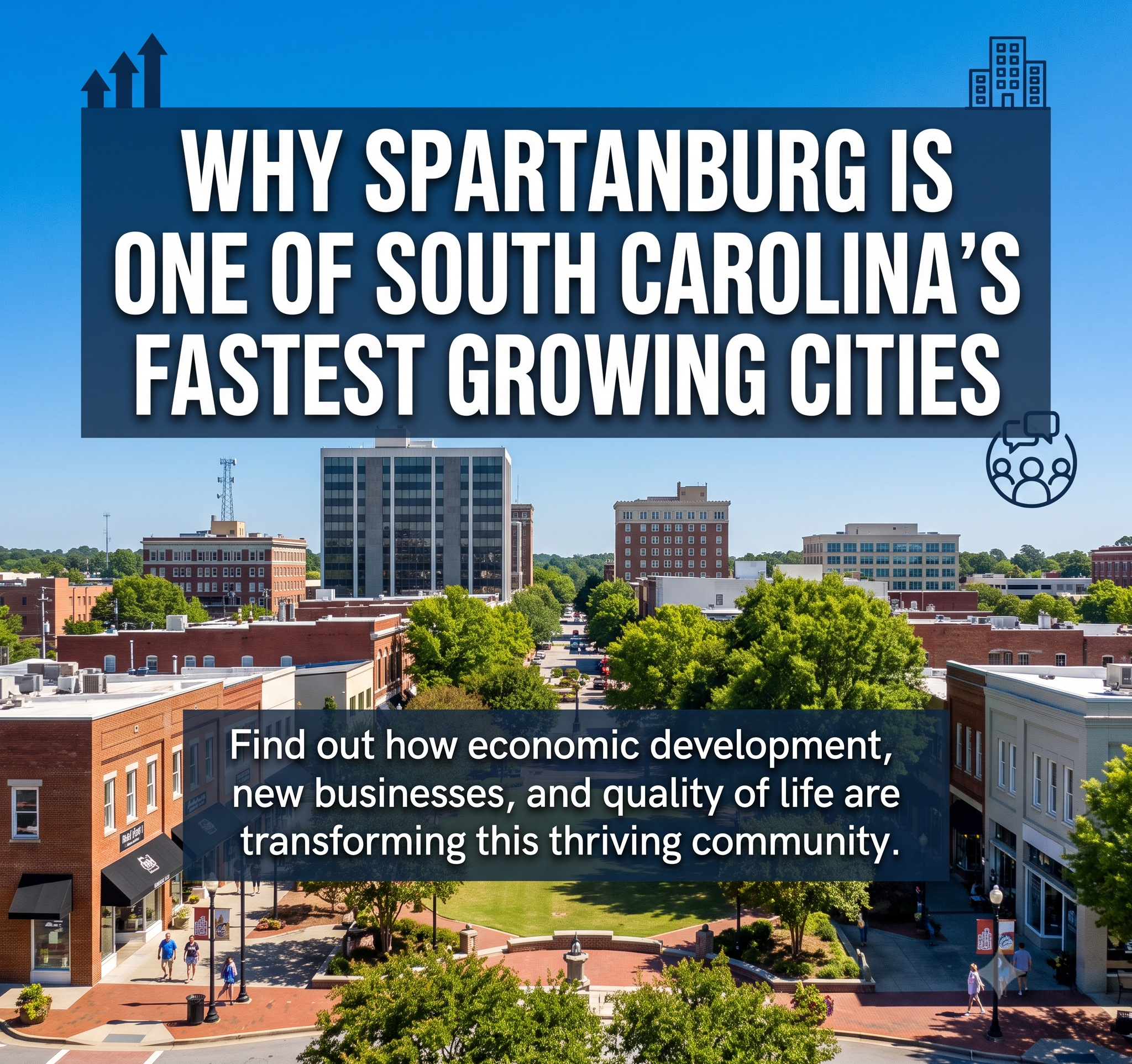
Spartanburg does not get the national attention that Greenville gets, but the growth numbers tell their own story. Over the past decade, Spartanburg has quietly become one of the fastest-growing cities in South Carolina. New residents, new employers, new construction, and a downtown that has reinvented itself have combined to shift what Spartanburg is and where it is headed.
If you are considering Spartanburg — as a buyer, an investor, or a seller trying to understand the market you are selling into — here is what I see as a working agent, and why the growth story matters for real estate decisions.
The Employer Base Has Diversified
BMW is the headline. Plant Spartanburg in Greer is the largest BMW production facility in the world by volume, and it continues to expand. The direct employment and the ripple effect through the supplier network drive a real share of Spartanburg County’s economic activity.
The Inland Port has been the second wave. South Carolina Ports built out the Inland Port to connect the Upstate to the Port of Charleston by rail, and that infrastructure pulled distribution centers, logistics operators, and warehousing employers across Spartanburg County.
Healthcare has grown as a major employer. The Spartanburg Regional Healthcare System and its expansion into new facilities and specialty services has added thousands of jobs across a range of skill levels.
Higher education anchors part of the local economy. Wofford College, Converse University, USC Upstate, and Spartanburg Community College collectively employ significant numbers of faculty and staff and bring in a steady flow of students and their families.
Advanced manufacturing beyond BMW has grown quietly. Multiple mid-sized manufacturers have chosen Spartanburg County for expansion, drawn by the workforce, the logistics infrastructure, and the cost of doing business.
The Downtown Has Reinvented Itself
Ten years ago, downtown Spartanburg was quiet after five p.m. That has changed. Restaurants, breweries, event venues, live music, and residential lofts have transformed downtown into a real destination.
The residential piece matters. New downtown apartments and lofts have brought residents into the city center, which changes the daily rhythm of the downtown economy. Downtown residents support restaurants at lunch and dinner, they walk in the evening, and they attend the events that make downtown feel like a real neighborhood.
Historic neighborhoods around downtown have benefited. Converse Heights and the surrounding historic districts have seen investment, restoration, and renewed buyer interest. Values in these neighborhoods have appreciated meaningfully.
The Cost of Living Story
Spartanburg has stayed more affordable than Greenville. For families relocating from higher-cost markets, that gap matters. Home prices per square foot, property taxes, insurance, and daily cost of living all run more accessible in Spartanburg than in comparable Greenville neighborhoods.
Spartanburg real estate shows the range — from historic downtown-adjacent inventory to established suburban neighborhoods to newer construction in the surrounding areas. The variety is wider than most out-of-state buyers expect.
Who Is Moving Here
The Spartanburg buyer pool has diversified alongside the employer base.
Working families tied to BMW, the Inland Port, and the broader Spartanburg County employer network continue to be the largest segment. Schools, commute access, and cost of living all support this buyer profile.
Out-of-state relocators looking for Upstate affordability with a real city offering land in Spartanburg often, particularly after comparing Greenville and finding the price gap meaningful.
Retirees from higher-cost markets, particularly the Northeast, have become a growing share. Spartanburg’s cost of living, healthcare access, and quieter pace all appeal to this demographic.
Downtown professionals, remote workers, and empty nesters drawn to the downtown lifestyle. This segment was minimal a decade ago and has grown substantially.
College-related buyers — parents buying property during their child’s time at Wofford or Converse, alumni returning to the area, faculty and staff — make up a steady share of specific neighborhoods.
Investors targeting single-family rentals in the more accessible price ranges have shown up in growing numbers. Rental demand from the BMW and Inland Port workforce supports this activity.
The Housing Market Response
Growth has driven meaningful changes in the local housing market.
New construction has accelerated across multiple corridors. Production builders have moved into the county in large numbers, particularly along the Highway 290, Reidville Road, and Highway 9 corridors.
Resale inventory has stayed tight. Existing homes turn over quickly when priced correctly. Sellers who prepare well and price realistically continue to see strong activity.
Prices have appreciated steadily. The pace is more measured than in some overheated national markets, which has kept the overall market healthy rather than volatile.
Rental demand has grown, supporting investor activity and pushing rents up alongside home values.
For a snapshot of what current listings look like, Spartanburg just listed inventory shows what is coming into the market at any given time.
What the Growth Means for Different Market Participants
For buyers, the growth story means acting decisively when the right home appears. The market does not reward indecision. Well-priced inventory moves quickly.
For sellers, the growth story supports strong pricing but does not eliminate the need for preparation. A well-prepared home in a growing market sells fast and near ask; a poorly prepared home in the same market can still sit.
For investors, the growth story supports both single-family rental and specific segments of the multifamily market. Cap rates have compressed as prices have risen, but the underlying demand fundamentals remain healthy.
For long-term holders, the growth trajectory supports continued appreciation. Spartanburg is not likely to slow down in the next several years, and the compound effect of steady growth adds up over time.
The Risks to Watch
Growth stories are not immune to reversals, and Spartanburg has its own risks worth understanding.
Concentration in specific employers matters. BMW is enormous for Spartanburg County; a meaningful slowdown at BMW would affect the local economy. That risk is real, though the auto industry’s long-term commitment to South Carolina appears strong.
Infrastructure has to keep pace with growth. Traffic, schools, and utilities all face pressure as populations rise. How the region responds affects both quality of life and property values.
Interest rate cycles affect affordability. Even in a strong growth market, rate spikes can compress buyer pools and slow the pace of appreciation.
None of these are reasons to bet against Spartanburg; they are factors worth watching as you make specific real estate decisions.
The Long View
Spartanburg’s growth story is likely to continue for the foreseeable future. The employer diversification, the downtown reinvention, the cost-of-living advantage over Greenville, and the demographic tailwind from out-of-state relocation all point to continued demand.
For real estate participants, that means treating Spartanburg as a market with meaningful long-term upside. Specific decisions still require specific analysis, but the underlying story is positive.
If you want to look at what the growth means for a specific property, a specific neighborhood, or a specific buyer or seller situation, that is the kind of conversation worth having with someone who works this market. Reach out and we can dig into the specifics.