


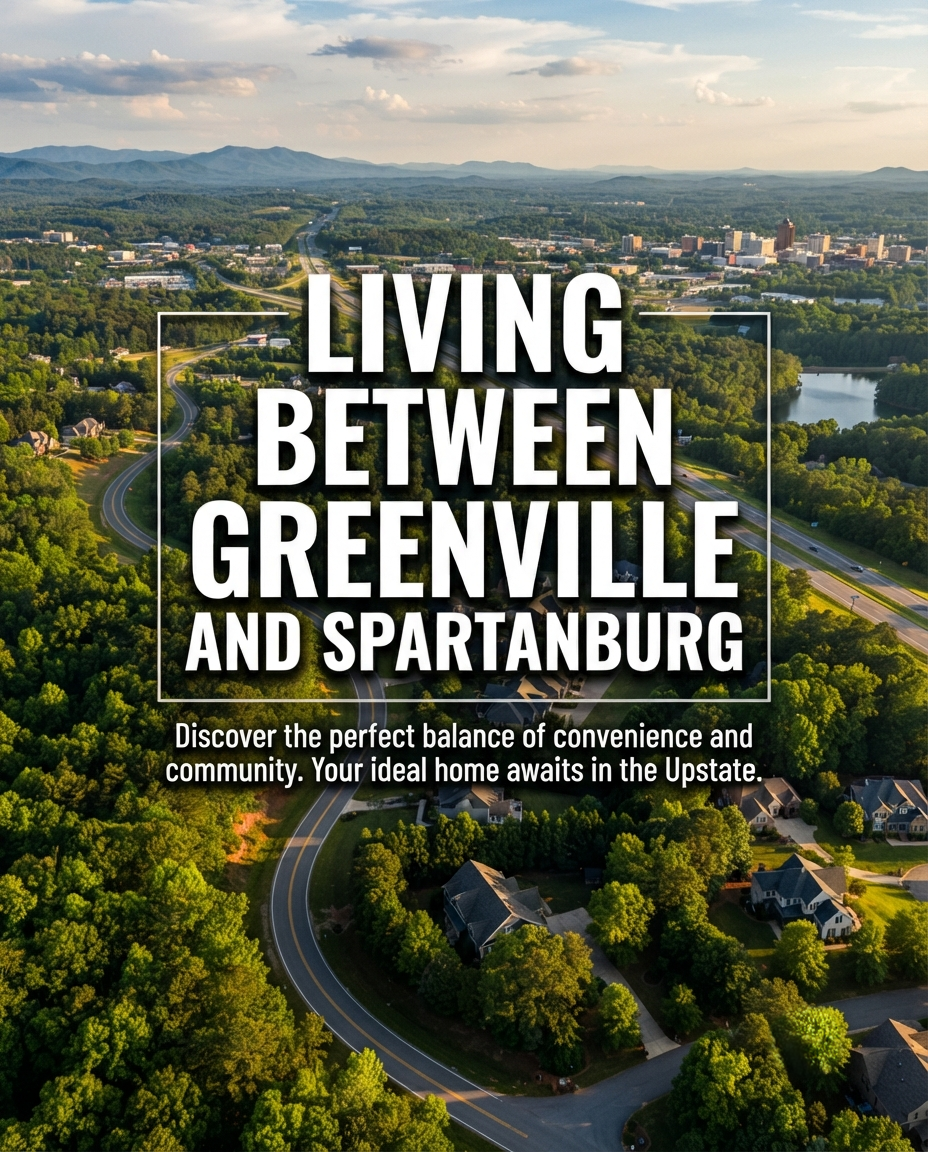
The stretch of Upstate South Carolina between Greenville and Spartanburg is one of the fastest-growing corridors in the state. What used to be quiet countryside connecting two mid-sized cities has become a real residential landscape of its own. New communities, retail, schools, and infrastructure have filled in the gap. For a growing number of buyers, this in-between corridor is the answer.
Here is what I see as a working agent in this market — who is choosing to live between the two cities, what the housing landscape looks like, and what to think about as you consider it.
The Case for Living in Between
For decades the default advice was: pick a city. Greenville or Spartanburg. The in-between was for people who could not decide. That has shifted, and for good reasons.
The corridor between the two cities now has real infrastructure. Grocery stores, restaurants, healthcare facilities, and schools are all within reasonable distance of most in-between addresses. What used to feel like living out in the country now feels like living in a suburban corridor with genuine services.
Commute access is exceptional. I-85 runs through the corridor, and quick access to both Greenville and Spartanburg is available from most in-between locations. For families where one parent works in each direction, the geographic math finally works.
Cost of living stays competitive. Homes along the corridor generally run less per square foot than equivalent inventory in either Greenville or Spartanburg proper, particularly in the more established neighborhoods within each city.
The buyer pool has diversified. Where the corridor used to attract mainly local families, it now draws out-of-state relocators, remote workers, and empty nesters as well.
The Communities That Make Up the Corridor
Several distinct communities anchor the in-between corridor.
Duncan sits along I-85 and has become a real destination for buyers tied to BMW, the Inland Port, and the broader logistics hub. New construction, schools, and family-friendly neighborhoods have grown alongside the employment base.
Greer real estate covers one of the strongest sub-markets in this corridor. Greer’s downtown revitalization, BMW proximity, and schools have made it a primary destination in its own right, not just an in-between option.
Lyman, further along the corridor, offers a mill-town history combined with recent growth. New construction has accelerated here, and the town’s trajectory has changed noticeably over the past decade.
The Reidville Road corridor on the Spartanburg side offers newer construction, family-friendly neighborhoods, and easy access to both cities. The area has grown from farmland to a real residential market in ten years.
The Highway 290 and Highway 14 connectors between these communities carry additional new construction, resale inventory, and rural properties that appeal to buyers wanting more land.
Who Is Choosing to Live In Between
The corridor draws a diverse buyer pool that has grown as the area has developed.
Working families where parents commute in different directions find the geographic split works better here than in either city proper. School zoning and family-oriented neighborhoods support the family lifestyle.
BMW and Inland Port employees have historically been the largest driver. Executive-level positions, engineering roles, technicians, and logistics professionals all show up in meaningful numbers.
Out-of-state relocators discover the corridor after starting their search in Greenville or Spartanburg and realizing the cost math works better in between. Many end up choosing the corridor for the combination of price and location.
Remote workers who want reasonable proximity to both cities without committing to either one find the corridor attractive. The internet infrastructure has improved, which makes remote work practical for more buyers.
Investors have shown up in growing numbers. Rental demand from the BMW workforce, the schools driving family demand, and the growth trajectory all support investment activity.
The Housing Market
Inventory in the corridor runs across a wide range.
New construction has been the dominant story. Production builders have built out communities along Highway 290, Reidville Road, and the connectors near I-85 in impressive volume. Pricing typically anchors from the high $200s into the mid $500s depending on community, plan, and lot.
Resale homes from the 2000s and 2010s in established neighborhoods offer family-friendly floor plans at pricing that often works better than newer construction. Many of these homes turn over with steady demand.
Older homes and rural properties on larger lots offer entry-level pricing or acreage for buyers willing to trade suburban amenities for more land and privacy.
Luxury inventory exists but is less concentrated than in Greenville or in specific Spartanburg County luxury neighborhoods. Custom homes on larger parcels represent much of the higher-end market here.
For the broader Greenville-area picture, Greenville real estate shows what alternatives look like in Greenville proper. For the Spartanburg side, Spartanburg real estate shows what alternatives look like there. Comparing across both plus the in-between corridor helps clarify what matters to you.
What to Think Through Before Committing
Living in the corridor is not for everyone. A few things worth considering.
- Downtown amenities are further away. If you want to walk to dinner most nights, live downtown. The corridor requires driving for that experience.
- School zoning matters and varies by specific address. Verify current zoning rather than relying on generalized district reputation.
- Traffic on I-85 and the local corridors is real. Drive your potential commute at actual rush hour to understand your daily reality.
- Infrastructure has grown but has not caught up to all the growth. Water and sewer, schools, and roads all face pressure as populations rise. Talk to current residents about what has been strained.
- Utility structures vary. Some new construction is on municipal water and sewer; some properties are on well and septic. Understand what applies.
- The corridor character is suburban, not urban. Buyers used to walkable urban living take time to adjust to car-oriented daily life.
How the Corridor Fits Long-Term
Living in between has become a real lifestyle rather than a compromise. Buyers who choose the corridor generally value flexibility on commute direction, family-oriented neighborhoods, and reasonable pricing more than they value dense downtown access.
For families, the trajectory has been positive. Schools have grown and improved. Amenities have caught up to population. Community infrastructure has continued to expand.
For long-term holders, the fundamentals support continued value. The employer base is stable and expanding. The demographic tailwinds continue. The geographic advantage of sitting between two growing cities is durable.
The Long View
The corridor between Greenville and Spartanburg is not going back to being farmland. The next decade will likely bring continued new construction, continued retail development, and continued infrastructure investment. Buyers entering now are paying more than they would have five years ago, but the underlying story supports the prices and the demand.
If you are weighing the corridor against picking a city, or if you already know the corridor is where you want to be and need to sort through specific neighborhoods and price points, that is exactly the kind of search where local knowledge matters. Reach out and we will put together a tour that fits how you actually want to live here.