


Closing costs surprise a lot of buyers. You saved up for the down payment. You budgeted for the mortgage. Then a week before closing, someone hands you a settlement statement with a total that includes thousands you weren't expecting. Here's what actually goes on that statement, why it costs what it does, and how to plan.
What "Closing Costs" Actually Means
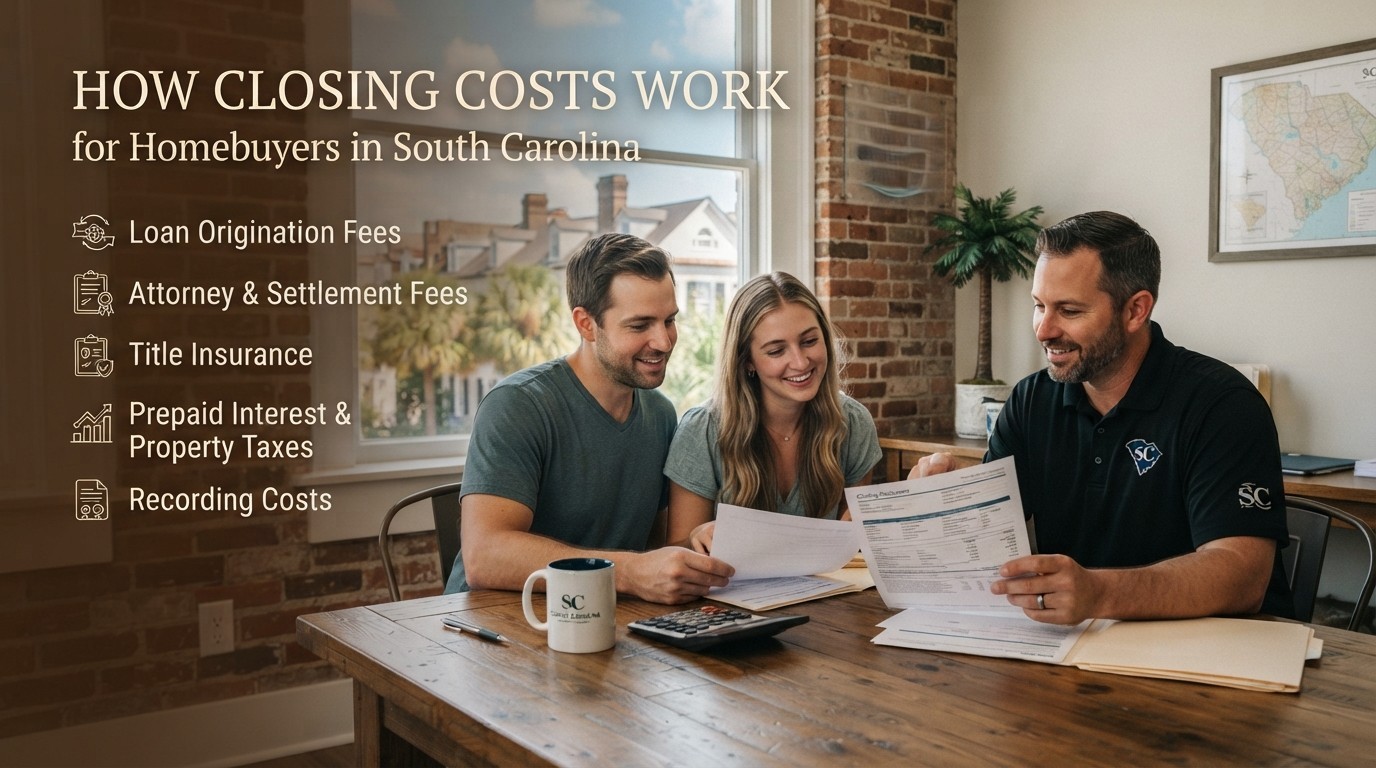
Closing costs are the fees you pay at settlement beyond the down payment. Some go to your lender. Some go to third parties like the title company, attorney, inspector, and insurance carriers. Some go to the state or county.
In South Carolina, expect closing costs to run roughly 2% to 5% of the purchase price for buyers. That range is wide because the actual number depends on your loan type, the specific lender, and the property details.
The Major Line Items
Lender Fees
Your mortgage lender charges fees for underwriting your loan. These include origination fees, application fees, credit report fees, and sometimes discount points if you're buying down your rate.
Total lender fees typically run $1,500 to $5,000 depending on the loan and lender. Compare these across multiple lenders before choosing — the difference can be real money.
Title Insurance and Attorney Fees
South Carolina requires an attorney at closing. This is different from many other states. The attorney handles the paperwork, title search, and the actual closing meeting.
Title insurance protects the lender (and optionally you) from any title issues that surface after closing. Lender's title insurance is required. Owner's title insurance is optional but usually recommended.
Attorney and title costs together typically run $1,000 to $2,500.
Appraisal
Your lender orders an appraisal to confirm the property is worth what you're paying. In the Upstate, appraisals typically run $500 to $700 for a standard single-family home.
Inspection
Not technically a closing cost since you pay the inspector directly, but worth budgeting. Home inspections in the Upstate run $350 to $600, with add-ons for well, septic, radon, or pool testing.
Prepaid Escrow Items
At closing, your lender collects several months of property taxes and homeowners insurance to fund your escrow account. This isn't really a fee — it's money you'd pay anyway, just paid upfront.
Depending on when in the year you close, escrow prepaids can be $2,000 to $5,000 or more.
Recording Fees and Transfer Taxes
South Carolina charges deed recording fees and a state deed stamp, which is essentially a real estate transfer tax. These typically run under $500 for average-priced homes.
HOA and Prorated Items
If the home is in an HOA community, you'll pay a transfer fee and any prorated dues. Property taxes and prepaid rent for investment property also get prorated at closing.
How to Estimate Your Closing Costs
The best number comes from your lender's Loan Estimate document, which they're required to provide within three days of your loan application. That document shows every fee your lender charges plus estimated third-party costs.
For a rough number before you have a Loan Estimate, use 3% of the purchase price as a working estimate for a typical Upstate purchase. That should get you close.
Who Pays for What
In South Carolina, buyers typically pay their own closing costs. Sellers pay theirs, which are different — mostly the agent commission.
That said, closing cost credits are negotiable. In many transactions, buyers ask sellers to credit some or all closing costs at closing. Whether the seller agrees depends on the market, the negotiation, and the specific deal.
For markets like Greenville real estate, Spartanburg real estate, and Boiling Springs real estate, seller-paid closing costs come up regularly in negotiations. A skilled agent can help you understand when to ask and how.
Frequently Asked Questions
Can I roll closing costs into my mortgage?
Sometimes yes, depending on the loan type and the appraisal. If the appraised value supports it, some loans allow you to finance closing costs. Talk to your lender about the options.
How is South Carolina different from other states?
South Carolina requires an attorney at closing, which some other states don't. The state also has specific title and recording processes. Your closing costs will look similar to nearby states but the itemization may be slightly different.
When do I actually pay the closing costs?
At closing. Your attorney will tell you the exact amount you need to bring or wire a day or two before. Most closings today use wire transfers for the final amount.
Are closing costs tax deductible?
Some are. Prepaid mortgage interest, points, and prepaid property taxes may be deductible. Consult a tax professional for your specific situation.
Can I negotiate my closing costs?
Lender fees are somewhat negotiable across lenders — shop rates. Third-party fees like attorney, appraisal, and title insurance are less negotiable but you can sometimes shop them. Recording fees and transfer taxes are set by law.
About Greg Harrelson
CENTURY 21 Blackwell is proudly part of the Century 21 Harrelson Group family of offices led by Greg Harrelson, a powerhouse organization with more than 30 years of success across South Carolina. This partnership strengthens our reach while preserving what built our reputation: exceptional service, best-in-class marketing, and highly trained agents focused on protecting our clients' most important investments.
Greg Harrelson is a seasoned Realtor with more than 30 years of experience serving the Myrtle Beach and Grand Strand markets branching into North Carolina more recently. As the founder of Century 21 The Harrelson Group, Greg has built his career helping buyers, sellers, and investors achieve success in every corner of the coastal Carolina real estate market. His expertise spans residential homes, investment properties, land development, and coastal condos. Known for his deep local knowledge, innovative marketing strategies, and commitment to personal service, Greg consistently helps clients reach their real estate goals while navigating the ever-changing market with confidence and precision.