


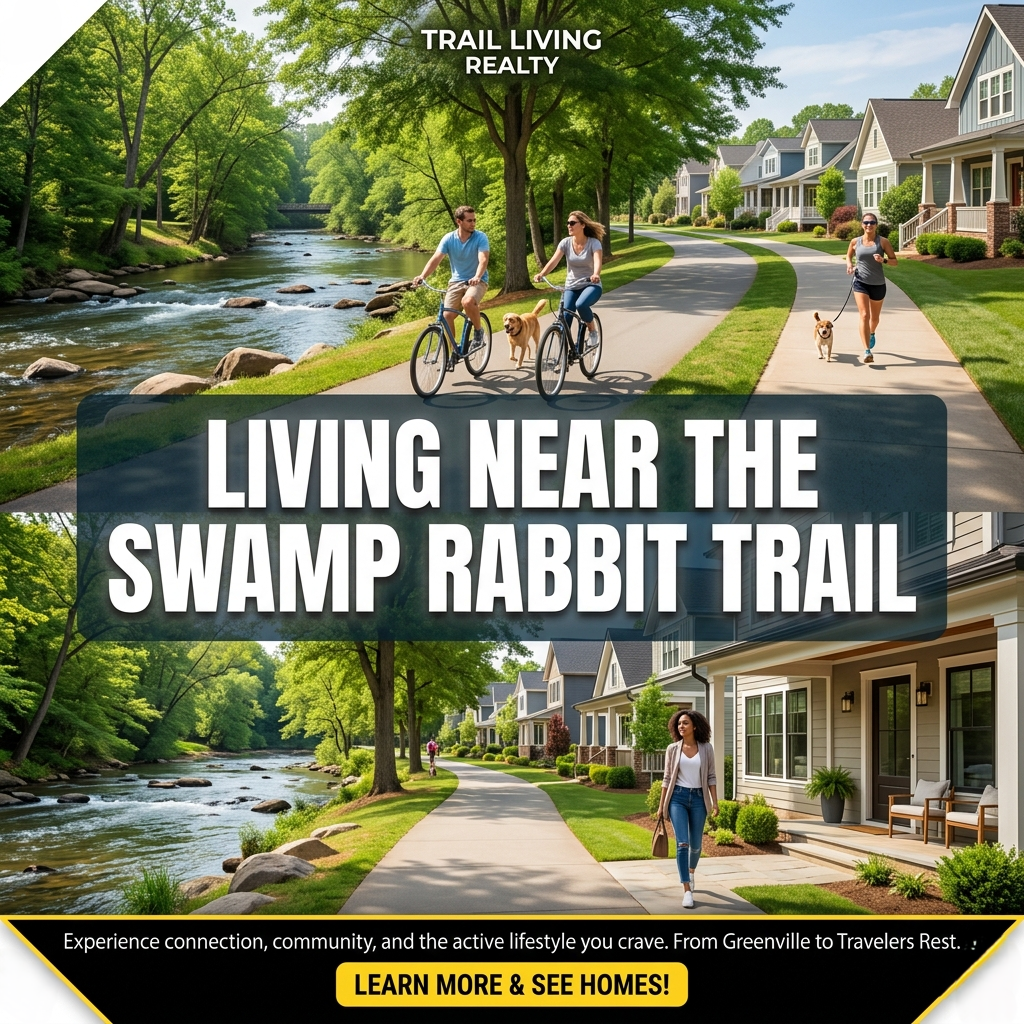
The Swamp Rabbit Trail is one of the biggest reasons buyers fall in love with the Upstate. It runs a little over twenty miles from Greenville up through Travelers Rest, threading along the Reedy River and out toward the foothills. For a lot of clients I work with, the question stops being “Where in the Upstate should we look?” and starts being “Which neighborhoods sit closest to the trail?” Once you have spent a weekend on it, that shift makes sense.
Buyers move here from Charlotte, Atlanta, Asheville, and as far away as the Northeast specifically because they want this kind of daily access to walking, biking, and the outdoors without giving up a real downtown. The trail makes that possible. Below is a practical look at what living near it actually looks like — what to expect from the housing stock, where the best access points are, and what to watch out for when you start touring homes.
Why Buyers Are Drawn to the Trail
The appeal is hard to overstate once you have spent time on it. Mornings on the Swamp Rabbit feel like a small-town greenway — runners, cyclists, parents with strollers, dogs, and the occasional person commuting into Greenville by bike. The path is paved, mostly flat, and wide enough for two-way traffic. You can ride from Furman University into downtown Greenville in well under an hour and barely think about traffic.
For homeowners, this translates into something specific: a daily lifestyle, not a weekend activity. Buyers who live close enough to walk or roll onto the trail tend to use it constantly. That changes how they think about driving, about gym memberships, about where they meet friends for coffee. It also shows up in property values along the corridor, which have held up well even in slower market cycles.
Travelers Rest: The Northern Anchor
Travelers Rest sits at the upper end of the trail and has built much of its modern identity around it. The downtown stretch along Main Street is walkable from several established neighborhoods, and new construction continues to push out toward Highway 25 and Geer Highway. If you want to be inside the city limits and within a short walk of the trail, look at homes near Trailblazer Park and the area south of downtown along Center Street. If you want more land and a quieter setting, the area up toward Cleveland and into the foothills still gives you trail access without the downtown noise.
For buyers exploring this market, Travelers Rest homes for sale is the right place to start. The inventory mix is interesting — you will see older bungalows in the historic core, mid-century ranch homes a few streets out, and a steady supply of newer construction in the surrounding areas. Pricing covers a wide range, which is part of why Travelers Rest works for first-time buyers and second-home owners alike.
Things to Know If You Are Buying Near Downtown TR
- Lot sizes are smaller than what you find further out, especially in the older sections
- Older homes often need updated electrical, HVAC, or roofing — get a thorough inspection
- Walkability is real here, but check the actual route to the trail; some streets get steep
- Short-term rental demand is strong, but the city has rules worth reviewing before you buy with that intent
Greenville Side of the Trail
The southern end of the trail runs into Greenville and connects right into Falls Park downtown. Neighborhoods along this side of the corridor have seen some of the most consistent appreciation in the region. If you are open to looking on the Greenville end, Greenville real estate offers a broader inventory, from historic cottages in North Main to newer townhomes closer to the river. The trade-off is price — being inside the Greenville city limits with trail access generally costs more per square foot than the same proximity in Travelers Rest.
If new construction is on your list, Greenville new homes is worth a look. Several builders have prioritized the corridor between Greenville and Travelers Rest, and a number of newer communities sit close enough to access the trail without driving.
Practical Considerations for Buyers
When clients tell me they want a home “on the trail,” I usually slow them down a little. Direct frontage on the trail is rare, and homes that border it tend to sell quickly and at a premium. What is more common — and often more livable — is a home a few blocks back, where you have a quiet street, a normal yard, and a five-to-ten-minute walk or ride to an access point.
A few things I tell every buyer touring this corridor:
- Check the actual access point. Some neighborhoods look close on the map but require you to cross a busy road or navigate a narrow shoulder to reach the trail.
- Pay attention to flood maps. The trail follows the Reedy River, and parts of the corridor sit in or near flood-prone areas. Insurance costs can move significantly within a few hundred feet.
- Look at older homes carefully. Many of the most charming streets along the trail have houses from the 40s, 50s, and 60s. Lovely homes, but plan for older systems.
- Think about parking and noise. Properties near trail access points sometimes see weekend overflow parking — usually not a problem, but worth knowing if you are sensitive to it.
Who This Lifestyle Fits
I see four buyer profiles consistently along the Swamp Rabbit corridor. Out-of-state retirees who want a walkable, active retirement and do not want a golf community. Remote workers who moved here during or after the pandemic and treat the trail as their daily reset. Young families who want their kids to grow up biking instead of being stuck in the car. And second-home buyers from Charlotte or Florida who use a Travelers Rest cottage as a long weekend base.
If any of those sound like you, the trail corridor is worth a serious look. The lifestyle is real, the inventory has range, and the long-term demand is unlikely to soften any time soon.
If you want to walk specific streets or compare a few homes side by side, that is what I do all day. Reach out and we will put a tour together that lines up with how you actually want to live here.