


Families relocating to Greenville almost always start with the same question: which neighborhoods are best for raising kids here? It is the right question, but the answer is more nuanced than a simple list of names. Greenville has a wide variety of neighborhoods that work well for families, each with its own character, price point, school zoning, and lifestyle fit.
Here is what I see as a working agent in this market and how to think about choosing among the strongest family neighborhoods in Greenville.
What Makes a Greenville Neighborhood Work for Families
A few factors I see families weighing consistently.
School zoning is usually the lead criterion. Greenville County Schools cover the city and surrounding areas, with significant variation across specific schools. Families typically have one or two non-negotiable school zones and weigh other factors within that constraint.
Walkability and community feel matter for some families and not others. Some want sidewalks, neighborhood parks, and other kids in the streets. Others prioritize larger lots and privacy.
Commute access affects daily life. Greenville is not a long-commute city by national standards, but the difference between a fifteen-minute and a forty-minute commute adds up over years.
Lifestyle amenities matter — proximity to parks, the Swamp Rabbit Trail, community pools, dining, and family activities all factor in.
Price point sets the realistic universe. Greenville has neighborhoods that work for families across a wide range of budgets, but each price range surfaces different options.
The Walkable Established Neighborhoods
Greenville has a handful of established neighborhoods inside or near the city limits that work especially well for families wanting walkable, community-feel environments.
Hollingsworth Park is one of the best examples of intentionally designed family-oriented community in Greenville. New-urbanist principles, sidewalks, parks, community amenities, and a master plan that prioritized family life. Prices reflect the desirability.
North Main and the neighborhoods around it offer historic charm, walkable streets, and access to Cleveland Park and downtown. Family inventory here ranges from older bungalows that need updating to renovated homes commanding meaningful premiums.
Augusta Road and the surrounding neighborhoods carry similar historic character with strong family demographics and excellent access to the southern side of downtown.
These neighborhoods tend to attract families who specifically value walkability and the established neighborhood character. They are not the cheapest option, but the lifestyle math works for many buyers.
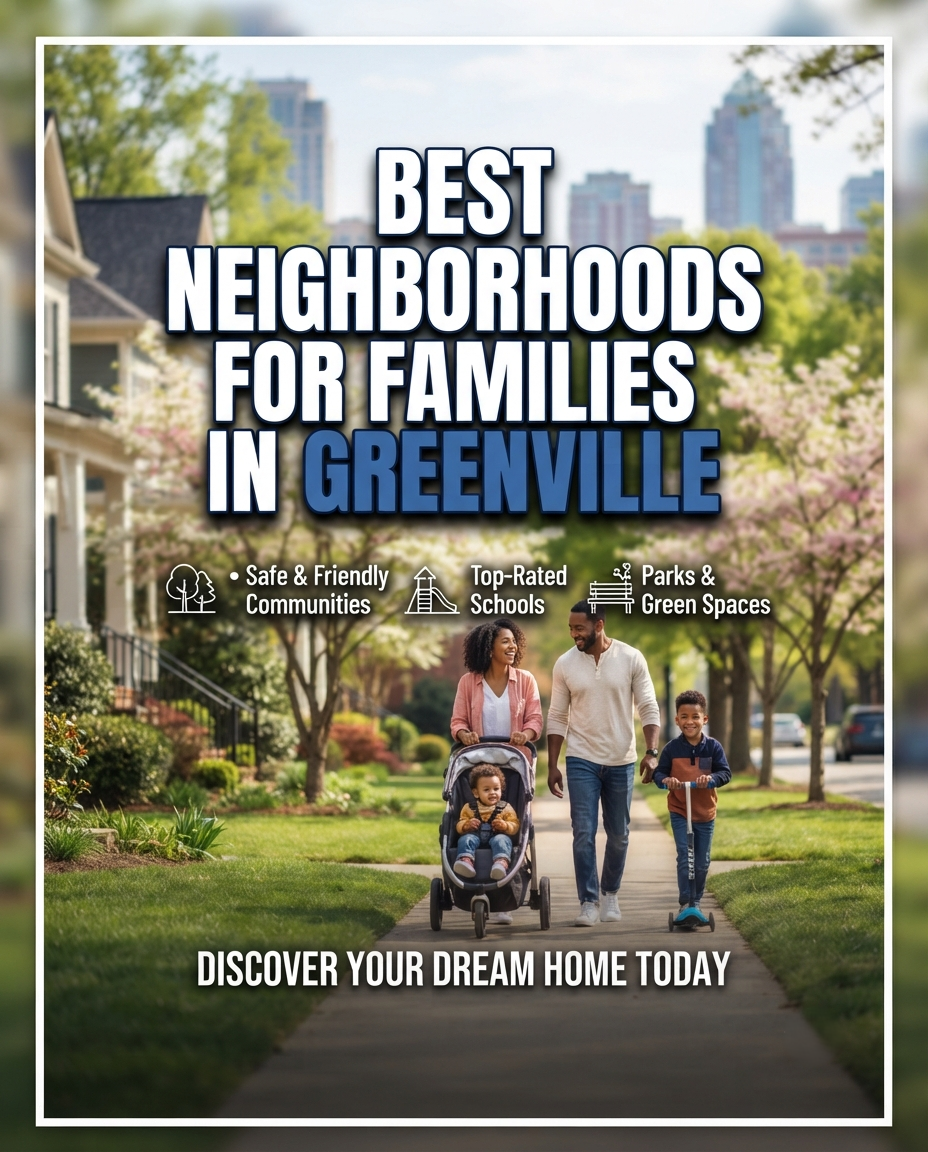
The Premium Master-Planned Communities
Greenville has a few master-planned communities that have set the standard for family-oriented living at higher price points.
Hartness sits on the eastern side of Greenville and represents one of the most carefully planned family-oriented developments in the area. Trails, parks, a village center, and a master plan that prioritizes community life have made Hartness a draw for families who can afford the price point.
Other master-planned communities further out from downtown offer similar amenity packages at different price points and locations. The trade-off is typically newer construction at higher prices versus older established neighborhoods with character and walkability.
The Suburban Family Neighborhoods
Many families end up in Greenville’s suburban neighborhoods, which offer larger lots, newer construction, and more affordable price points than the in-town options.
The Eastside neighborhoods toward Pelham Road and the surrounding areas offer strong family appeal — established neighborhoods, good schools, and reasonable commute access.
Five Forks and the broader southern Greenville suburbs offer family-oriented neighborhoods with newer construction options and amenity-rich communities.
The Wade Hampton corridor and the eastern Greenville suburbs offer a mix of established and newer neighborhoods with strong family demographics.
Greenville new homes opens up the active builder inventory across multiple suburbs at various price points. Families looking specifically at new construction often find more options than they expected.
What to Check When Touring
A few things families should pay attention to in Greenville.
- School zoning. Verify the current zoning for the specific address. Do not assume based on neighborhood name or listing description.
- Walk the neighborhood. Visit at school drop-off, after school, and on a weekend evening. Different times of day give different pictures.
- Drive the commute. Real rush hour, not Saturday afternoon. The drive from a specific home to a specific workplace at the actual commute time matters.
- Look at the neighbors. Who lives there now? Are they likely to be there in five years? Long-term stability matters for kids forming friendships.
- Check HOA structures. Some neighborhoods have HOAs that affect what you can change about your home; others do not. Understand the rules.
- Visit nearby parks, community centers, and after-school activity locations. Daily family life happens at these places, not just at home.
Where Greenville Fits Against the Suburbs
For families weighing Greenville proper against the surrounding suburbs, Greenville real estate offers the breadth of in-town and immediate-suburb inventory. Families wanting walkable downtown access usually choose Greenville. Families prioritizing more space and lower price points often end up in Simpsonville, Mauldin, Greer, Taylors, or other surrounding markets.
The right answer depends on how the specific family wants to live. There is no universal best.
The Long View
Greenville’s family neighborhoods have appreciated steadily because the fundamentals work. Schools draw families, families drive demand, and demand supports values. As long as those factors hold, Greenville’s strongest family neighborhoods should continue to be steady performers.
For families weighing where to land, the right next step is to spend some real time in two or three neighborhoods that seem promising. Walk the streets, eat at the neighborhood restaurants, drive the school routes, and pay attention to which one feels like home. That feel is usually right.
Reach out when you want to start touring. Family searches benefit from a careful look at school zoning, neighborhood culture, and the small details that matter for daily life with kids.