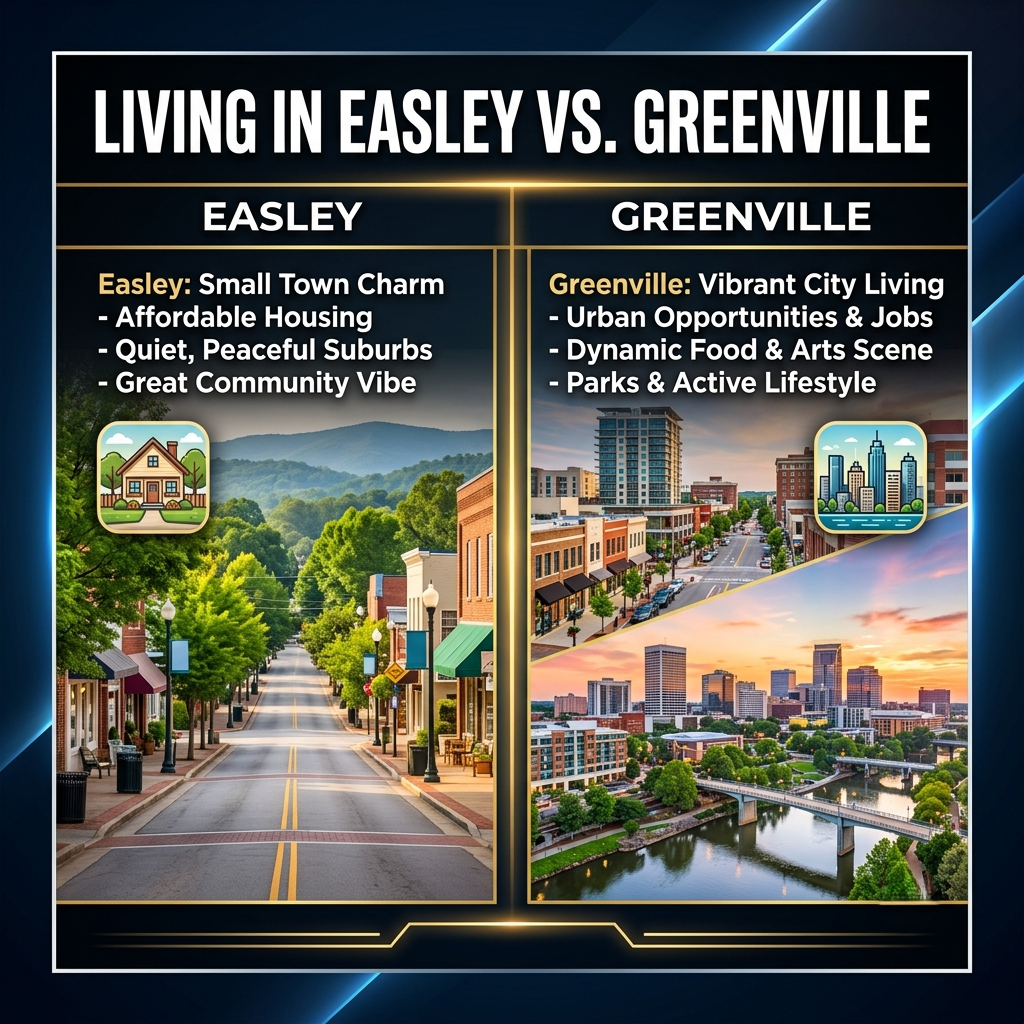
Buyers who are considering Easley and Greenville are usually choosing between two very different versions of Upstate life. Greenville has the downtown, the high-density walkable amenities, and the urban energy. Easley has the small-town feel, the proximity to the foothills, and the more affordable price points. Both are good answers depending on the buyer. The decision usually comes down to lifestyle priorities and budget.
I work with buyers comparing these two markets on a regular basis. Here is how the comparison actually plays out, what each city offers, and what to look for as you start touring.
The Big-Picture Difference
Greenville is the larger market by a meaningful margin and offers a more urban experience. Downtown Greenville has restaurants, music venues, parks, museums, and a density of amenities that feels metropolitan. Easley, twelve miles west of downtown Greenville along Highway 123, has its own downtown but on a much smaller scale. The lifestyle skews more residential, more outdoorsy, and more tied to the foothills and the lakes than to a busy downtown scene.
That difference shapes almost everything else — the housing stock, the buyer profile, the price points, and the daily rhythm of life in each place.
Price and Value Comparison
The single biggest reason buyers consider Easley is price. Easley homes for sale consistently shows more square footage and larger lots per dollar than equivalent inventory in Greenville real estate, especially when comparing similar build years and finish levels.
A few patterns I see consistently:
- Single-family homes in Easley often run 15 to 25 percent less than similar Greenville homes in comparable condition
- Lot sizes in Easley tend to be larger by default; smaller urban lots are more common in Greenville
- New construction in Easley is generally more affordable than equivalent new construction in Greenville
- Resale homes in established Easley neighborhoods offer strong value, particularly for buyers willing to update older finishes
The trade-off is the urban experience. You give up walking distance to Greenville’s downtown and the density of amenities that come with it.
The Lifestyle Question
This is where I encourage clients to think hard about how they actually want to spend their time.
Greenville works best for buyers who want to walk to dinner, attend events downtown regularly, take advantage of the food scene, and value short drives to amenities. Buyers who tell me they want to be able to leave their car at home for the weekend are usually best matched in Greenville.
Easley works best for buyers who want a quieter daily life, who plan to spend weekends in the foothills, on the lakes, or at home in their yards, and who do not mind driving twenty to thirty minutes when they want a Greenville experience. Buyers who tell me they want a real garage, a yard for their kids, and a slower pace usually find what they want in Easley.
There is no wrong answer. It just has to match the lifestyle the family actually lives.
Schools
Greenville and Easley are in different school districts. Greenville falls under Greenville County Schools; Easley is in Pickens County, primarily under the School District of Pickens County.
Both districts have strong schools. The decision is rarely about district quality at the macro level and more about the specific school zoned to a specific address. Verify the current zoning for any specific property and look at the actual elementary, middle, and high school combinations rather than assuming based on the district name.
Families relocating from out of state often find both districts compare well to what they left, particularly compared to large metropolitan school systems elsewhere.
Commute Patterns
Commute realities matter for the Easley vs. Greenville decision. A few things to think through.
If you work in downtown Greenville, expect 20 to 30 minutes from much of Easley, depending on time of day and exact location. Highway 123 carries the bulk of commuter traffic and gets heavy at rush hour.
If you work near GSP Airport, BMW, or the eastern side of Greenville County, the commute from Easley becomes longer and less practical. Greer or eastern Greenville would suit better.
If you work in Pickens, Clemson, or the western Upstate, Easley is the better choice. The commute is much shorter, and access to the mountains and Lake Hartwell becomes simpler.
If remote work is part of the equation, the commute argument matters less. The lifestyle and price questions become the primary drivers.
New Construction in Both Markets
Both Easley and Greenville have active new construction segments, but the price points and amenity expectations differ.
Easley new homes typically offer larger floor plans, larger lots, and lower base prices than equivalent Greenville new construction. Production builders have built significantly in Easley over the past several years, and the inventory mix is broad.
Greenville new construction often emphasizes amenities, walkability to retail, and density. The price per square foot runs higher, but the location and the amenity packages reflect that.
If you are weighing new construction in both markets, drive each builder’s communities and pay attention to what is included in the base price, what comes as an upgrade, and what the HOA covers.
What Easley Offers That Greenville Does Not
A few specific advantages on the Easley side.
Proximity to the foothills and the mountains. Easley sits closer to the Blue Ridge Escarpment, and weekend trips to Table Rock, Caesars Head, and the foothills lakes are much shorter from here than from Greenville.
Closer access to Clemson. For Clemson University parents, alumni, or people who work in Clemson, Easley keeps you within reasonable distance without the football-weekend traffic disruption of being in Clemson itself.
Quieter daily rhythm. Easley has less traffic, less noise, and less of the energy that comes with a growing downtown. For buyers who value that, the trade-off is worth it.
More land per dollar. If acreage matters, Easley generally delivers more for the same money.
What Greenville Offers That Easley Does Not
A few specific advantages on the Greenville side.
Downtown density. Restaurants, music, art, and events at a scale Easley does not match.
Healthcare access. The Prisma Health system and other major providers are concentrated in Greenville. Specialist care is closer.
Broader job market. Greenville has more employment options across more industries within a short commute.
Network effects. For families and professionals where social and professional networks matter, Greenville has more activity, more events, and more density of connections.
The Long View
Both markets are likely to keep appreciating. Greenville continues to attract national attention and out-of-state buyers. Easley continues to grow steadily as buyers prioritize affordability and lifestyle balance. Neither is a bad long-term decision in real estate terms.
The right answer is the one that matches how you actually want to live. If you want to walk to dinner most nights, choose Greenville. If you want a larger yard, easier access to the mountains, and a quieter daily pace, Easley is likely the better fit.
If you are still weighing it, the right next step is to spend time in both. Eat dinner downtown in each, drive the commute you would actually drive, and pay attention to which one feels like home. Reach out when you want to start touring and we can put together a comparison that fits your situation.